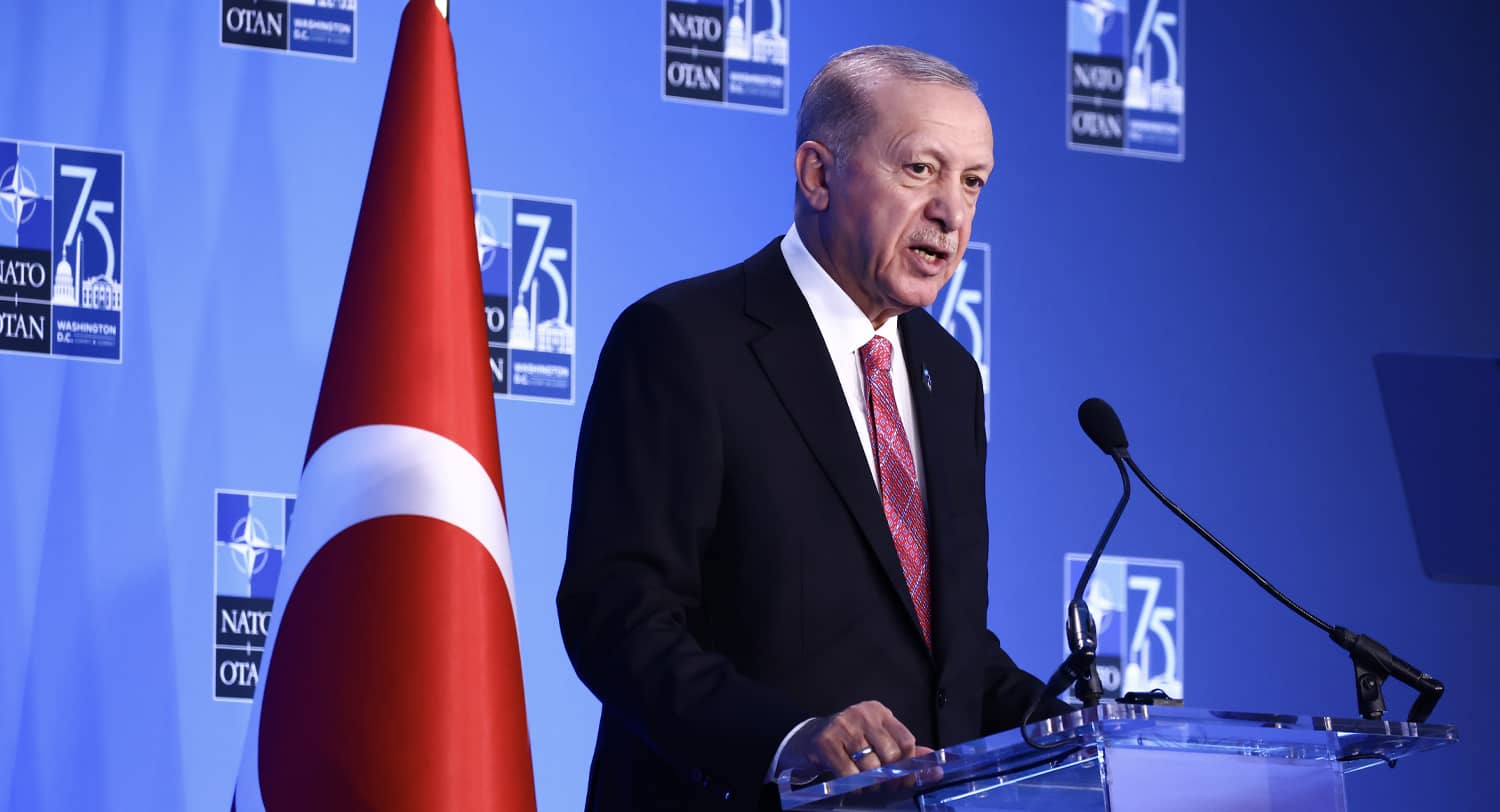
On July 12, at the NATO summit in Washington, Turkey threatened to take steps to exclude Israel from all cooperation with NATO. President Recep Tayyip Erdoğan said that “until comprehensive, sustainable peace is established in Palestine, attempts at cooperation with Israel within NATO will not be approved by Turkey.” This threat should be challenged by NATO members.
This is not the first time that Ankara has threatened NATO security and interoperability. Between 2022-2023, Ankara blocked NATO member consensus on expansion to Finland and Sweden. This decision was not due to bureaucratic or procedural impediments. It was simply a matter of Erdoğan leveraging Turkey’s membership in NATO to compel the United States to authorize the sale of F-16 fighter jets to Turkey. Without finding a way to make this happen, Erdoğan held NATO hostage, in order to get what he wanted. It worked. In return for finally approving Sweden’s application, the US authorized the sale of F-16’s in January 2024.
Erdoğan’s actions on NATO expansion were directly related to an earlier decision. In 2019, despite widespread objections by NATO members, Erdoğan proceeded with the purchase and acquisition of the Russian S-400 air defense system, triggering U.S. sanctions. In the hands of a country deploying the F-35 fighter, this system could have jeopardized the operational security of the F-35 fighter and its stealth capability, sharing sensitive information on the fighter with Russian authorities.Thus Turkey was denied the ability to acquire F-35’s, and it sought the next best alternative, F-16’s, in order to modernize its air force. This was Ankara’s choice. Nobody forced Erdoğan to acquire a defensive capability from a NATO adversary.
The S-400 issue remains unresolved. When periodically asked whether he might change his mind and possibly divest Turkey of the S-400s, Erdoğan unapologetically responds by stating that this “is a done deal.” The challenge for NATO, other than having to deal with a difficult member, is far greater: now that a member state has figured out that it can hold the alliance hostage, will it continue to wield this tactic?
Turkey is using the same tactics in attempting to prevent NATO’s cooperation with Israel. Turkey-Israel bilateral relations under Erdoğan have been a rollercoaster, depending on his transactional needs of the moment. Between 2010-2022, Erdoğan generally undermined Ankara’s historically strong bilateral relationship with Israel, for no other reason other than his personal ideological preferences. Most recently, however, prior to the October 7 Hamas invasion and Israel’s response, he had been courting Israeli Prime Minister Benjamin Netanyahu.
For Erdoğan, supporting Hamas is more important than maintaining Turkey’s strategic ties with Israel. Beginning in 2011, Erdoğan invited Hamas to establish a presence in Turkey. Since October 7, Erdoğan has frequently and publicly sided with Hamas. In July 2024, Turkey threatened to invade Israel, accusing it of having territorial aspirations on Turkish soil and claiming that Hamas was the only buffer preventing this from happening. Following the killing of Hamas’ political chief, Ismail Haniyeh, Erdoğan declared a national day of mourning.
Erdoğan’s Islamist worldview, deeply antisemitic and anti-Israeli, inform his country’s actions. Turkey is the only country in NATO to champion the cause of Hamas, which is designated as a terrorist organization under the laws of the US, EU and Canada.
Other NATO members have reservations about Israeli operations in Gaza. Spain, for example, has objected to Israeli tactics and accuses Israel of purposefully harming Palestinian civilians. But no NATO member other than Turkey actively supports Hamas.
Israel is a vital security partner of NATO especially in the fields of counterterrorism, intelligence sharing, and maritime cooperation in the Mediterranean. Israel also shares military technology, for instance on artificial intelligence, with NATO’s military committee. Its inability to coordinate activities with NATO and engage in joint military exercises would harm NATO readiness, preparedness and cohesiveness.
Following Erdoğan’s threat to invade Israel, Israeli Foreign Minister Israel Katz called on NATO to expel Ankara from the alliance. Under present organizational rules, there is no means to expel a member. Nevertheless, Turkish statements and actions should not simply be ignored. Turkey can and should face a cost for its efforts to use its NATO membership in ways that undermine the core values and collective security of its members, particularly given the challenges from Russia and Iran. A public rebuke of Turkey by its NATO allies would be a start.